
Lodi Previous Residents Source Timeline
A backward Lodi address trail changes source as it crosses the online land-record boundary. Begin with the most recent Lodi tax and parcel identity, use recorded instruments for the documented ownership sequence, then move to library, archive, and repository channels for older Lodi clues. The table separates confirmed coverage from leads whose exact shelf or digital availability still needs verification.
| Source | Years It Covers | Where Held | What It Shows |
|---|---|---|---|
| Bergen land-record index | January 1, 1970 to present | Bergen County Clerk online portal | Recorded parties, instruments, dates, and book/page or file references |
| Older deeds and microfilm | Before the online cutoff, record-specific | County Clerk, State Archives, FamilySearch, or Bolger | Earlier ownership-document research route |
| Lodi Directory of 1933 | 1933 | Lodi Memorial Library history lead | Local directory lead; exact shelf or scan is not verified |
| Lodi and Lodi/Passaic directories | 1910, 1915, and 1920-1922 grouping | Newberry guide and catalogue routes | Dated directory leads; verify volume and page |
| Federal census schedules | Released schedules relevant to the research date | Library databases and historical repositories | Household-level context when a date and place align |
| Building and zoning files | Historic coverage not confirmed | Lodi Building or Zoning route | Permit, inspection, certificate, or planning history |
For Lodi previous residents in the recent record period, start with the assessment identity and Clerk index. For an earlier Lodi era, shift channels instead of assuming that an online no-result means the record never existed.
Lodi Previous Residents Start Here
Before following Lodi previous residents, establish the property identity in the Lodi assessment search. The borough instructions support Location, Owner Name, Block, Lot, and “Qualifer” searches and say block, lot, and qualifier generally work best. For an address entry, use the Lodi door number and street name without a common suffix.
Then compare the Lodi result with the Bergen parcel viewer or the published parcel schema. Carry the Lodi block, lot, qualifier, address form, and PAMS PIN into the next stage. An assessment owner, however, is not proof that the named person lived at the Lodi situs address.
The identifiers from a Lodi assessment result create the starting point for a dated address history.
Once the Lodi parcel identity is secure, the land-record search can be narrowed by legal town, block, lot, dates, and parties rather than by a street number alone.
Lodi Previous Residents Before 1970
The Bergen County land-record portal states online coverage from January 1, 1970 to the present. That is a Lodi online-index boundary, not a declaration that earlier Lodi deeds are absent. When the sequence reaches that point, contact the Bergen County Clerk, consult the New Jersey State Archives catalogue, check FamilySearch, or use Bolger Heritage Center’s repository resources for older books, microfilm, maps, directories, and newspapers.
The County Clerk is at One Bergen County Plaza in Hackensack and lists 201-336-7000 for routing. For a copy request, the Clerk’s current fee page lists certified copies at $10 for the first page and $2 for each additional page. That differs from the fee to record a new instrument, so a Lodi researcher should say which service is being requested.
Lodi Previous Residents Deed Trail
A Lodi deed trail begins with the present assessment spelling and legal tax-map keys, then moves backward through the Bergen Clerk index. The portal offers Party Name, a second-party field, document type or group, date range, book/page, Clerk file number, consideration, legal town/lot/block, map number, and linked-document choices. Use the Lodi legal filters and dates to keep a common surname from pulling in another parcel.
- Record the Lodi assessment address, block, lot, qualifier, and current spelling of the assessment owner field.
- Search that Lodi party or the legal town/block/lot fields in the Bergen Clerk index and open the recorded purchase deed.
- Read the grantor and grantee roles, instrument type, recording date, consideration if shown, and book/page or Clerk file number.
- Search the earlier seller as a grantee, using Lodi legal fields and a date range to locate the prior purchase.
- Repeat backward through the Lodi sequence, checking linked documents, until the online coverage boundary requires an older repository route.
- Grantor / grantee
- The grantor transfers or conveys an interest in the Lodi instrument; the grantee receives it. The indexed role matters when walking backward.
- Chain of title
- A sequence of recorded ownership documents associated with a Lodi parcel. It is a document trail, not legal proof of title.
- Legal description
- The town, block, lot, map, or other parcel description used to distinguish a Lodi property when an address form changes.
- Criss-cross directory
- A dated address-first directory that can give an historical Lodi occupant or business lead, subject to the edition’s omissions.
The Bergen land-record help page documents the searchable fields and linked-document workflow used for this Lodi deed research.
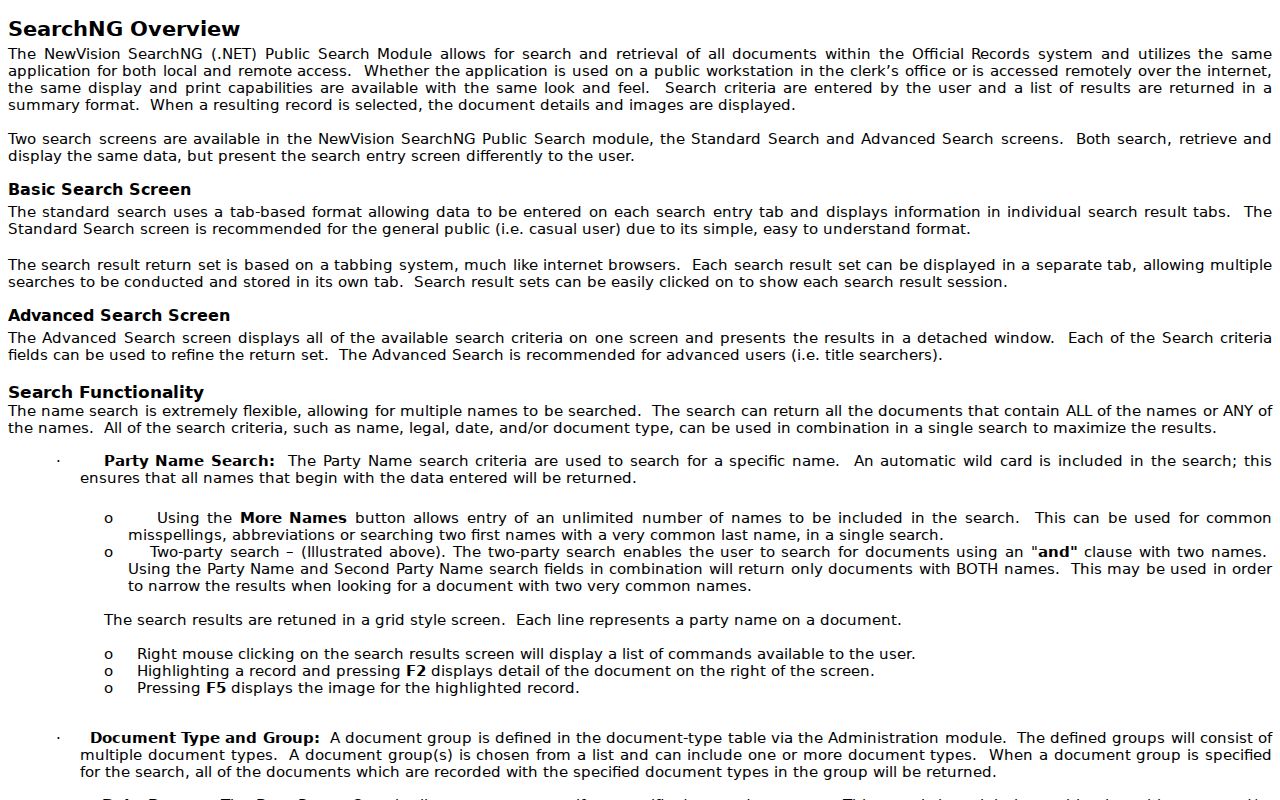
Linked records may include assignments, releases, satisfactions, or corrections. Preserve the relationship shown by the index rather than assuming every linked item transfers ownership.
Lodi Previous Residents by Date
Directories and census schedules add the household layer that a Lodi deed cannot provide. Use them as dated evidence: a directory means a person or business was listed at an address in that edition, while a census schedule needs to be read in the context of its enumeration date and locality. Neither should be made to say who is at the Lodi address now.
- Choose a Lodi deed date or a dated Lodi directory entry as the first fixed point.
- Locate the directory edition nearest that Lodi date and copy its locality label, page, spelling, and address exactly.
- Pair it with the census schedule closest to the same Lodi period, checking the municipality and address evidence before treating names as a match.
- Compare the Lodi result with parcel, deed, newspaper, or map context and label conflicts rather than silently resolving them.
The local history page identifies Peter M. Galanti’s Lodi Directory of 1933, but neither a shelf record nor a scan was verified. For the broader shelf, consult the Lodi city-directory collections page and ask Lodi Memorial Library staff about access.
Lodi Previous Residents and Labels
Older records may call the place Lodi Township, Lodi, or place some Lodi material under Passaic. Lodi Township was organized in 1825, and Lodi became a borough on December 22, 1894. Newberry’s guide lists Lodi in 1910 and 1915 and groups Lodi/Passaic material for 1920-1922. Preserve the locality printed by the source, because a catalogue grouping is not proof that a person or address lay in a different place.
Local history note. The Lodi Memorial Library’s 1933 directory lead is valuable precisely because it is specific. Treat it as a dated starting point and ask the library to verify the edition, page, and shelf location before drawing a Lodi address conclusion.
Lodi Previous Residents Map Gaps
Maps help test a Lodi address story, but only as context. The Library of Congress Sanborn guide explains how to search by state, city, date, sheets, notes, and digital files; no Lodi-specific Sanborn sheet was located in this research. The Library of Congress Bergen County maps record can provide regional context for old roads, sites, houses, and land grants, but it is not a Lodi map.
For a longer Lodi trail, Bolger Heritage Center offers directories, newspapers, maps, church histories, family files, and on-site databases, with original historic materials available by appointment. The New Jersey State Archives preserves older public records and should be searched by catalogue or contacted for the relevant Bergen collection. These are Lodi research channels, not evidence that a particular record has already been located.
When a Lodi address trail reaches an estate question, the FamilySearch Bergen probate catalogue is a docket and index starting route for 1714-1962. It can point a researcher toward a file or reference; it does not establish that a person was connected to the Lodi parcel without matching record evidence.
Lodi Previous Residents Limits
Lodi previous residents research can establish an ownership-document sequence or a dated address lead. It does not prove continuous occupancy, identity, family relationships, present location, or legal title. A chain can also include a business, trust, correction, mortgage-related document, or redacted field. Keep the exact Lodi source and date alongside any conclusion, and ask the official custodian or a qualified title professional when legal proof is needed.
Household evidence should be kept separate from the ownership chain. A newspaper notice, cemetery entry, probate file, or directory listing can supply a date-specific lead, but each has its own repository, wording, and possible error. Bolger's published holdings include newspapers, church histories, family files, and directories, while the State Archives and FamilySearch offer collection-level paths for older records. No verified Lodi obituary index or local cemetery search was located in this research. Record that gap instead of filling it with an unsupported name or address connection.
For a Lodi government record that is not posted, the Borough Clerk’s OPRA page calls for a narrow record description. The New Jersey framework is N.J.S.A. 47:1A-1 et seq. and generally has a seven-business-day response framework, subject to exemptions, extensions, archival timing, and protected records. It does not override voter, DMV, court, vital, or protected-address limits.
Lawful use. Use Lodi previous-residents research for family history, personal property history, civic understanding, or an estate and heir question. Never use a Lodi address trail to track, harass, intimidate, or harm a living person.