
Lodi Street-by-Street Discovery
A Lodi street search works best as an address-to-record walk-through. The Lodi assessment result supplies the tax identity; the Bergen parcel layer supplies geographic context; the Bergen Clerk index supplies recorded instruments. A lawful voter-status check or an old directory can sometimes add a dated residency lead, but Lodi property records do not prove occupancy. Treat each step as a different kind of evidence and write down the source and date before moving on.
- Search the Lodi address in the assessment portal and record its block, lot, qualifier, and any assessment owner field.
- Compare that Lodi tax identity with the Bergen parcel viewer or its published parcel schema for map context.
- Use the Lodi legal town, block, and lot to narrow the Bergen Clerk land-record search.
- Inspect the recorded deed and linked instruments, preserving the parties, date, and book/page or file number.
- For a past Lodi household lead, check dated directory and census sources rather than turning a property record into a current-resident claim.
The Lodi address should stay attached to its municipal and legal identifiers throughout the process. A matching surname is not enough when the Clerk index, parcel layer, and historical sources may each use a different spelling or locality label.
Lodi Street Directory Assessment Route
The Borough’s assessment instructions direct a Lodi researcher to choose Bergen County and then Lodi in the tax portal. One search key is enough, although the Lodi guidance says block, lot, and qualifier generally work best. If the tax identifiers are unknown, enter the door number and street name without a suffix. An owner last name plus street name is an alternate, not confirmation that the owner lives at the Lodi situs address.
The Borough’s assessment-record search guidance is shown below as the first Lodi address-research checkpoint.
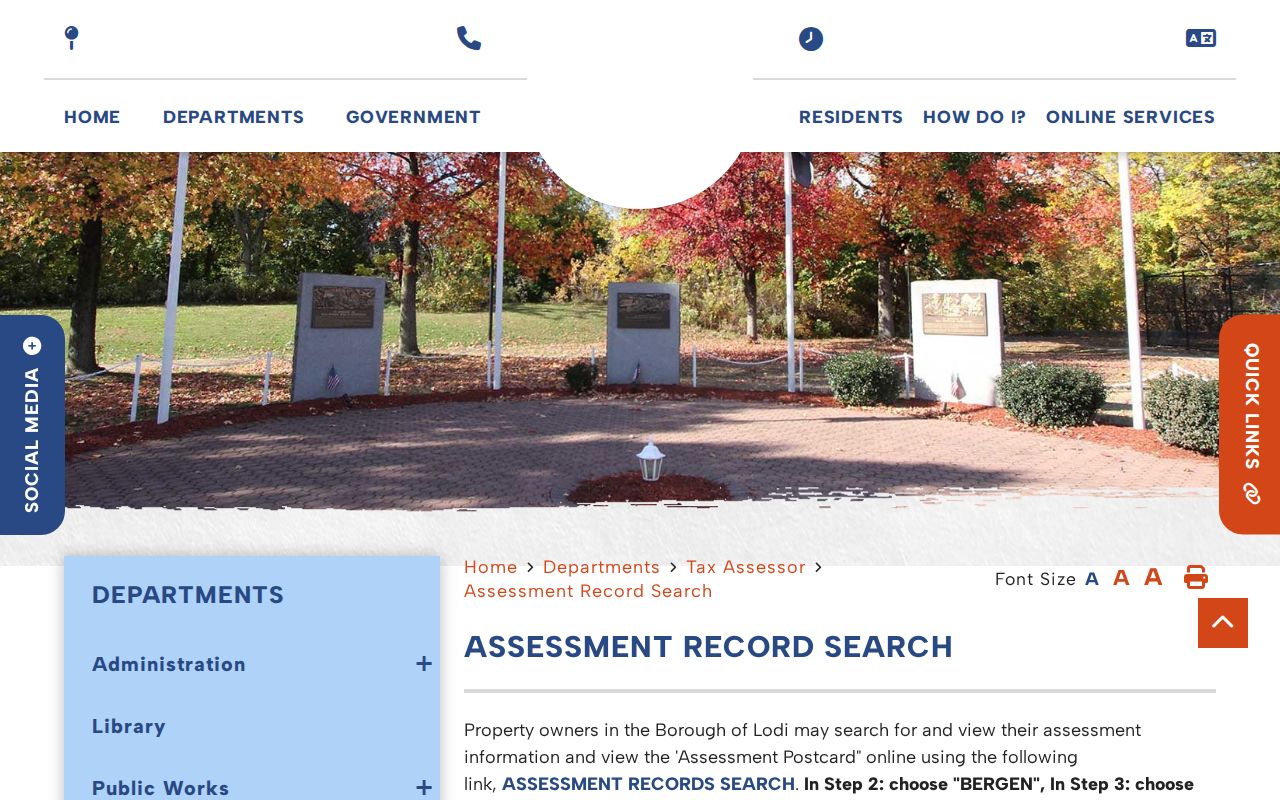
That guidance is useful because it keeps a Lodi address query tied to the tax system’s county and district selections before a result is compared with a parcel or land record.
The Lodi portal exposes More Info and Assessment Postcard after a result. Its formal historic coverage start, export capacity, and every select-menu option were not published in the material reviewed, so use it as a Lodi lookup tool rather than a complete historical database.
The Lodi assessment portal image below shows the source used for that limited address search.
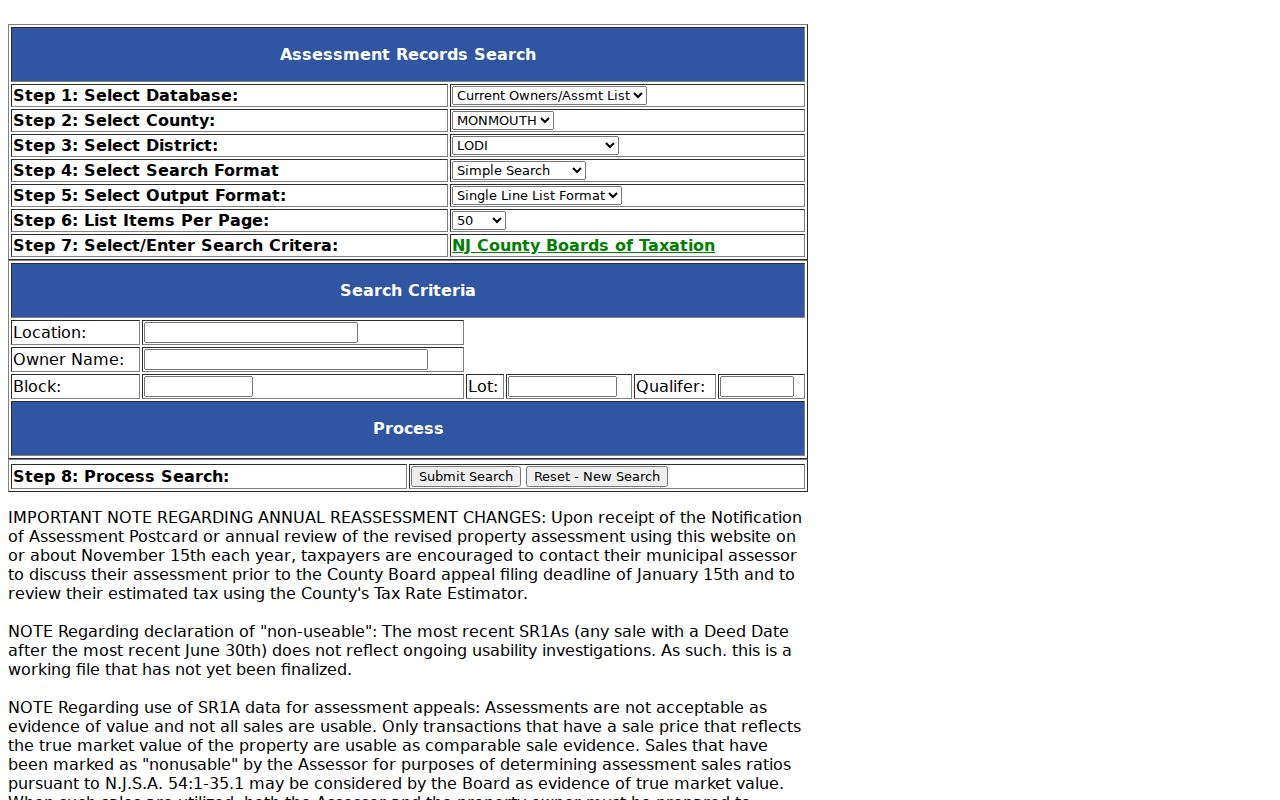
A Lodi assessment screen can lead to an assessment postcard or more detail, but it remains a tax-assessment record and is not a deed, survey, title opinion, or occupancy verification.
Here is the Lodi field set documented by the borough and portal. Preserve the portal spelling “Qualifer” when noting a query, since that helps another Lodi researcher repeat the same search.
| Lodi portal field | Use | Practical Lodi note |
|---|---|---|
| Select Database, County, District | Choose the assessment jurisdiction | Lodi instructions say Bergen, then Lodi |
| Search, output, and page controls | Set result presentation | Option lists were not exposed in the captured material |
| Location | Search a Lodi address | Use number and street name, omitting common suffixes |
| Owner Name | Alternate Lodi route | Try last name plus street name |
| Block, Lot, Qualifer | Legal tax-map key | Qualifier is especially useful for condominium records |
| Submit Search | Run the Lodi query | One field can be sufficient |
Lodi Street Records on Parcels
The Bergen County Parcel Viewer adds a map layer to the Lodi assessment result. The accompanying parcel service schema identifies fields such as ADDRESS, PAMS_PIN, municipality or town, block, lot, QCODE, street-number components, acreage, tax map, and last update. OWNER_NAME is also a template field, but Lodi and statewide protections can require redaction.
Do not invent a Lodi viewer control that was not captured. The live interface’s search labels, identify tool, printing, export, and layer toggles were not established by the research. The county data is useful for Lodi geographic context, not for a survey, legal boundary, title conclusion, or a complete list of people at an address.
The Lodi assessment card and Bergen parcel record should agree on the basic parcel identity before a deed search begins. If they do not, note the displayed date and seek clarification from the appropriate Lodi or county custodian.
Lodi Street Directory Terms
A few Lodi record terms prevent the wrong source from being asked the wrong question. They also make a street-by-street notebook easier to verify when an older Lodi label or address does not match the modern form.
- Parcel
- A mapped unit of land used in the Lodi tax and county GIS context. A parcel line is not a survey or legal boundary.
- Situs address
- The physical Lodi property address shown by a record. It can differ from an owner mailing address and does not prove occupancy.
- Plat or tax map
- A mapped reference that helps place a Lodi block and lot. It is context for research, not a substitute for a survey.
- Criss-cross directory
- A dated directory arranged by street and number rather than by name. It can provide an historical Lodi lead, not a current household list.
Lodi Street Directory Deed Trail
The Bergen County Clerk Land Records portal is the Lodi source for recorded deeds, mortgages, and related instruments. Its online coverage is stated as January 1, 1970 to the present. Use Party Name with its automatic trailing wildcard, then narrow a broad Lodi result with a date range and Legal Search fields for town, lot, and block. The help page also documents second-party, document type or group, book/page, Clerk file number, consideration, and map-number routes.
A Lodi address may lead to a recorded deed, but that document traces an ownership transaction, not every occupant. Follow linked documents with care: an assignment can relate to a mortgage, while a release, satisfaction, or correction can change how a prior entry is understood. For material before the online Lodi-era cutoff, the next routes are the County Clerk, the State Archives, FamilySearch, or Bolger Heritage Center.
The Clerk’s fee page separates a request for a certified copy, listed at $10 for the first page and $2 for each additional page, from recording charges. A deed with the stated tax abstract has a separate recording charge of $45 for the first page plus $10 per additional page. Confirm current fees with the Clerk before ordering.
Lodi Street Records for Permits
A Lodi address can also be a useful key for building and zoning files. The Building Department routes construction permits, inspections, certificates, and related forms; the Zoning Department routes zoning, site-plan, subdivision, hearing, road-opening, and soil-movement materials. These Lodi channels can help date work or an administrative event at a property.
The Lodi Building Department page shown here is the borough routing source for those address-linked records.
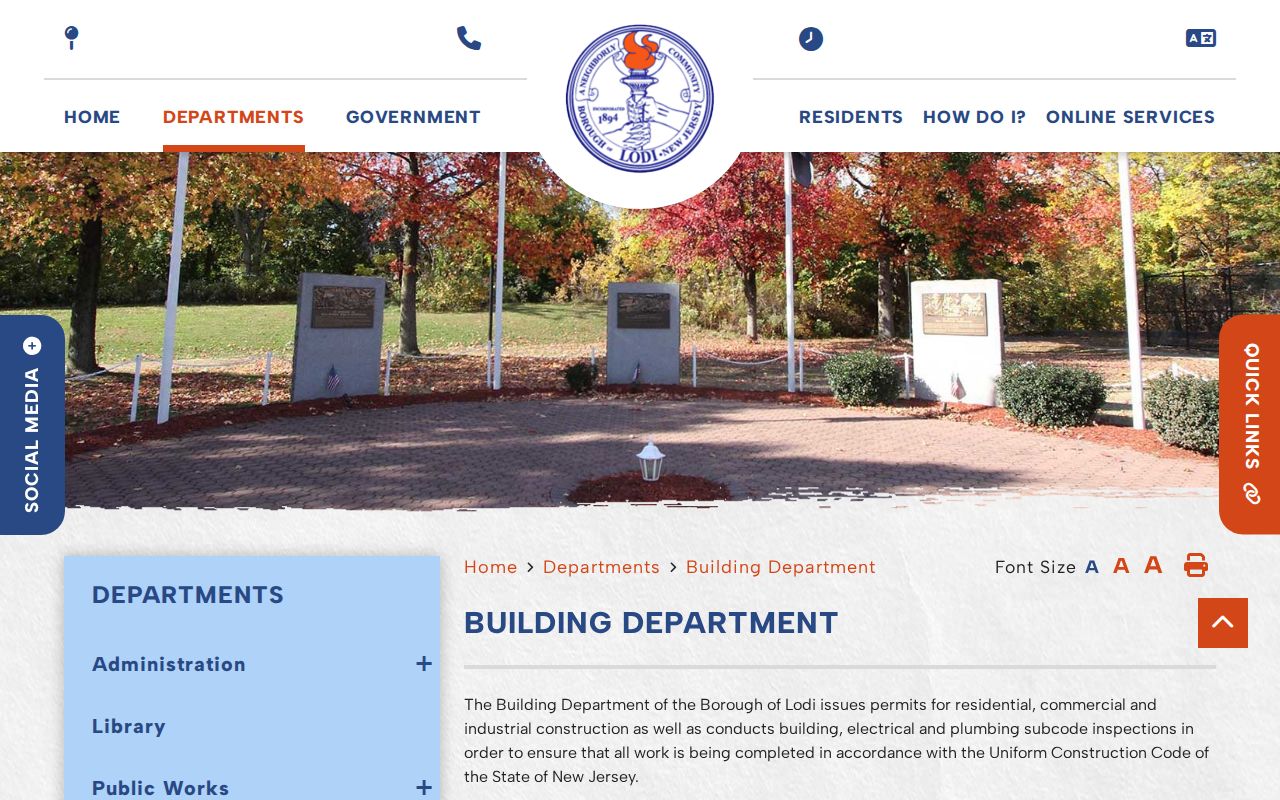
The Lodi page directs the requester to the relevant permit or inspection channel, which is different from a searchable historical index.
No complete Lodi historical permit index or digitized coverage was confirmed. A permit does not establish present use, occupancy, or a household. When a Lodi file is not posted, make a narrow request identifying the address or block and lot, record type, and date range rather than asking the borough to compile broad personal information.
Lodi Street Directory History Leads
For an older Lodi street address, use a dated directory as a lead and keep the edition year beside every entry. Lodi Memorial Library identifies a Lodi Directory of 1933 by Peter M. Galanti, but the specific shelf location and scan were not confirmed. The Lodi city-directory collections page gathers the historical shelf routes without turning a dated listing into a claim about today’s address.
Older Lodi material may be catalogued under Lodi Township or Passaic. No substantiated borough-wide renumbering or renaming history was located, so do not manufacture one to force a modern address match. Instead, preserve the printed locality label, compare legal descriptions and maps, and mark a possible number change as an unresolved question until a primary record confirms it.
Lodi Records Searchable by Street
Each Lodi address record has a narrow purpose. The table below shows the useful Lodi chain and its limits, so a result is not overstated as evidence of current residence or a complete household.
| Lodi record | Custodian | What the Lodi record can show | Important limit |
|---|---|---|---|
| Assessment card or postcard | Lodi Tax Assessor | Block, lot, qualifier, assessment owner, and address fields | No stated historic coverage or proof of occupancy |
| Parcel layer | Bergen County GIS | Parcel geometry, PIN, address, tax-map keys, and map context | Lines are not surveys; owner fields may be redacted |
| Recorded deed or mortgage | Bergen County Clerk | Parties, document type, recording date, book/page or file number | Online index begins January 1, 1970; not an occupant list |
| Building or zoning file | Lodi department route | Permit, inspection, certificate, site-plan, or hearing history | No complete historic digital index confirmed |
| Voter-status record | New Jersey elections system | Only fields available through permitted access | No street-wide export or live UI details confirmed |
| Dated directory | Library or repository | Past address or business lead in that edition | Not a current or complete household record |
For Lodi research, carry forward the address, block, lot, qualifier, PAMS PIN, and deed book/page or file number as each becomes available. A Lodi street name joins sources, but the legal parcel keys make the chain more reliable.
Keep Lodi Parcel IDs Together
The most useful Lodi research habit is to preserve different identifiers instead of treating them as interchangeable. The Lodi assessment block, lot, and qualifier identify the tax record; the county PAMS PIN identifies parcel data; the Bergen Clerk book/page or file number identifies a recorded instrument. A Lodi address can change form over time, but this group of identifiers lets a researcher explain why two Lodi records may concern the same place.
Insider tip. Block/lot/qualifier, PAMS PIN, and deed book/page are different Lodi and Bergen identifiers. Record all of them with the source date before comparing an assessment, parcel, and land-record result.
Lodi Street Directory Postal Limits
Use a USPS result to check Lodi postal formatting or routing, then return to Lodi assessment, parcel, and deed sources for property research. A ZIP result does not prove that a person or organization is at the address, and it does not define a municipal or parcel boundary. This matters when a Lodi address is being reconciled with a historic directory or a tax record.
Limits of a Lodi Street Directory
A Lodi street directory cannot reveal every person connected to an address. Records do not supply a complete list of occupants, utility customers, DMV addresses, protected voters, household relationships, or unrecorded moves. The federal Driver’s Privacy Protection Act restricts personal DMV information. Daniel’s Law, voter rules, and other protections can also redact or limit a Lodi name or address.
The New Jersey voter-status page is a status route, not a confirmed street-by-street roster. Its live controls were not captured, and no street-wide Lodi export was confirmed. If a Lodi municipal record is needed and no direct channel exists, the Borough Clerk’s OPRA route requires a narrow description of a specific government record. OPRA is not a way to request a dossier.
Lawful use. Use Lodi street and property records for personal, lawful research, family history, civic understanding, or a documented property question. Never use a Lodi record to stalk, harass, intimidate, or harm another person.